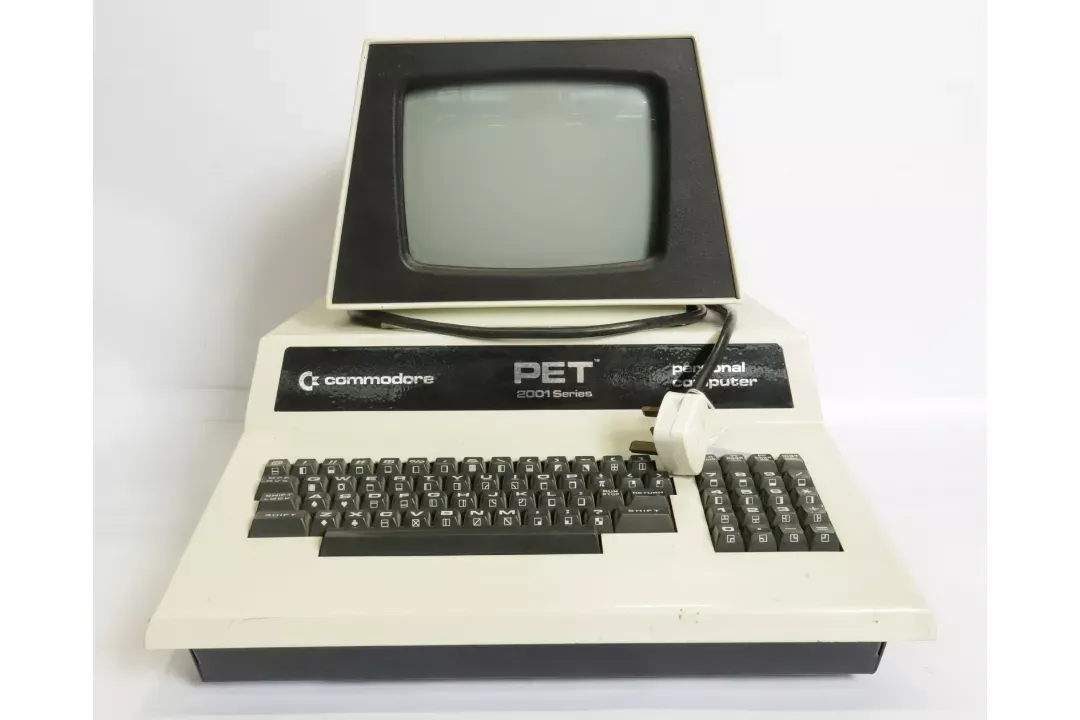
A second PET has joined the collection: a Commodore PET 2001 series machine with the full-size graphics keyboard. It has a UK plug, and although the case is yellowed, it looks complete. It makes a good comparison with the original chiclet-keyboard PET 2001.
// HISTORY
The original PET's chiclet keyboard was cramped and its built-in cassette deck took up space. In 1979 Commodore redesigned the machine as the 2001-N. It had a full-size keyboard with PETSCII graphics symbols printed on the keycaps, a separate numeric keypad, and an external cassette drive (the Datassette). Memory options went up to 32K, and new ROMs brought BASIC 2.0, which fixed bugs and allowed larger memory.
This layout became the standard PET design for the next few years. It led on to the 4000 series and, with an 80-column screen, the CBM 8032.
// SPECS
CPU ........ MOS 6502 @ 1 MHz
RAM ........ 8K, 16K or 32K
DISPLAY .... 9" monochrome CRT, 40x25 text, PETSCII graphics
STORAGE .... external Datassette, IEEE-488 disk drives
BASIC ...... Commodore BASIC 2.0
I/O ........ IEEE-488, user port, 2x cassette ports
KEYBOARD ... full-size graphics keyboard with numeric keypad
// HOW IT WAS USED
The 2001-N was a favourite in schools. Many British students took their first programming lessons on a PET just like this one. Thanks to its better keyboard and larger memory, it was also more practical for businesses, which used it with IEEE-488 disk drives and printers. The graphics symbols on the keys made it easy to type PETSCII art and simple games straight from the keyboard.
// WHAT'S NEXT
Here's the plan before it gets switched on:
[ ] identify the exact model and RAM fitted
[ ] clean the case and keyboard
[ ] inspect the PSU and replace any suspect capacitors
[ ] power up on a variac and check the CRT
Progress updates will be posted here. For more vintage machines, see the hardware section.