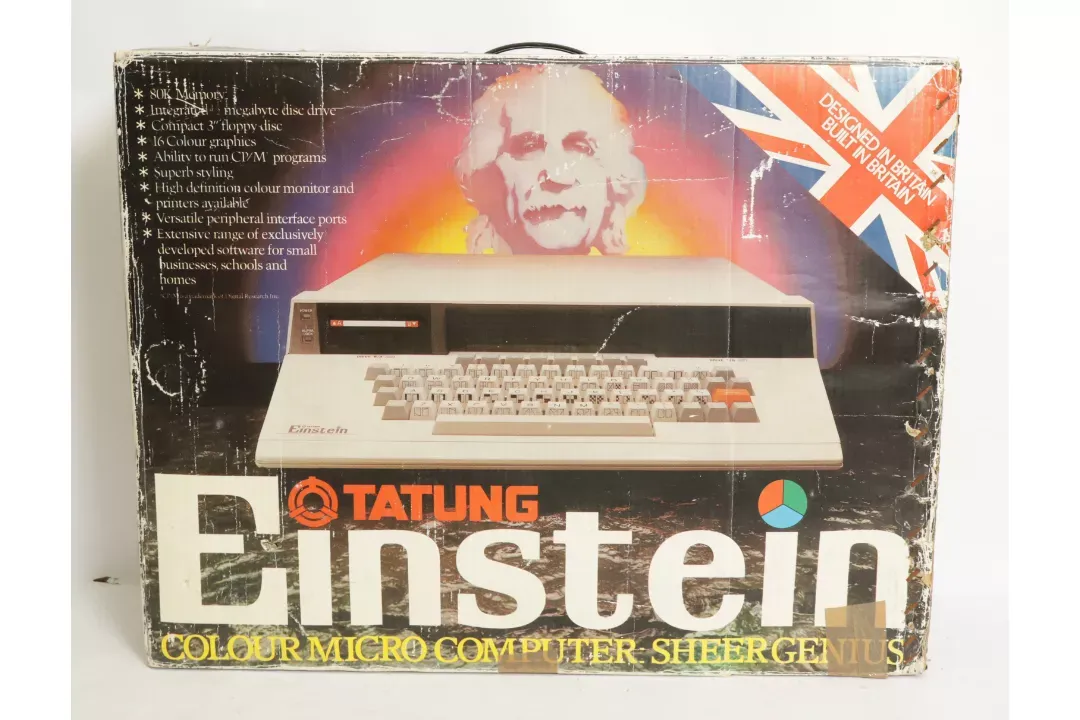
A new machine has joined the collection: a Tatung Einstein in its original box. The box is battered and scuffed, but the striking artwork is still there: Albert Einstein's face over a sunset, a Union Jack reading "Designed in Britain, Built in Britain", and the slogan "Colour Micro Computer: Sheer Genius".
// HISTORY
Tatung is a Taiwanese electronics company that ran a TV factory in Telford, Shropshire. In 1984 it launched the Einstein TC-01, which was designed and built in the UK. It cost around £499. That was far more than a Spectrum or Commodore 64, but it came with a disk drive built in at a time when most home users loaded software from cassette.
The Einstein never became a big seller with home users. It found a different niche: it was popular with games studios as a development machine. Its fast disk storage and serial ports made it a good host for writing and cross-assembling code for the ZX Spectrum, Amstrad CPC and MSX.
// SPECS
CPU ........ Z80A @ 4 MHz
RAM ........ 64K, plus 16K video RAM
VIDEO ...... TMS9129, 256x192, 16 colours, 32 sprites
SOUND ...... AY-3-8910, 3 channels
STORAGE .... built-in Hitachi 3" floppy drive, room for a second
OS ......... Xtal DOS (runs CP/M software)
I/O ........ RS-232, Centronics printer, user port, analogue joysticks, Tatung Pipe expansion
// HOW IT WAS USED
Tatung marketed the Einstein to small businesses, schools and homes, as the list on the box says. Because Xtal DOS could run CP/M programs, it had access to business software such as WordStar and dBase II. It also had its own BASIC and a modest library of games, many of them conversions from MSX, which used similar graphics hardware.
Its longest-lasting role was as a developer's workstation. Several well-known 8-bit games were written on Einsteins and then sent over a serial link to the target machine for testing.
// WHAT'S NEXT
Here's the plan before it gets switched on:
[ ] unbox and inspect the machine
[ ] check the internal PSU and replace any suspect capacitors
[ ] replace the 3" drive belt
[ ] power up and boot Xtal DOS
Progress updates will be posted here. For more vintage machines, see the hardware section.