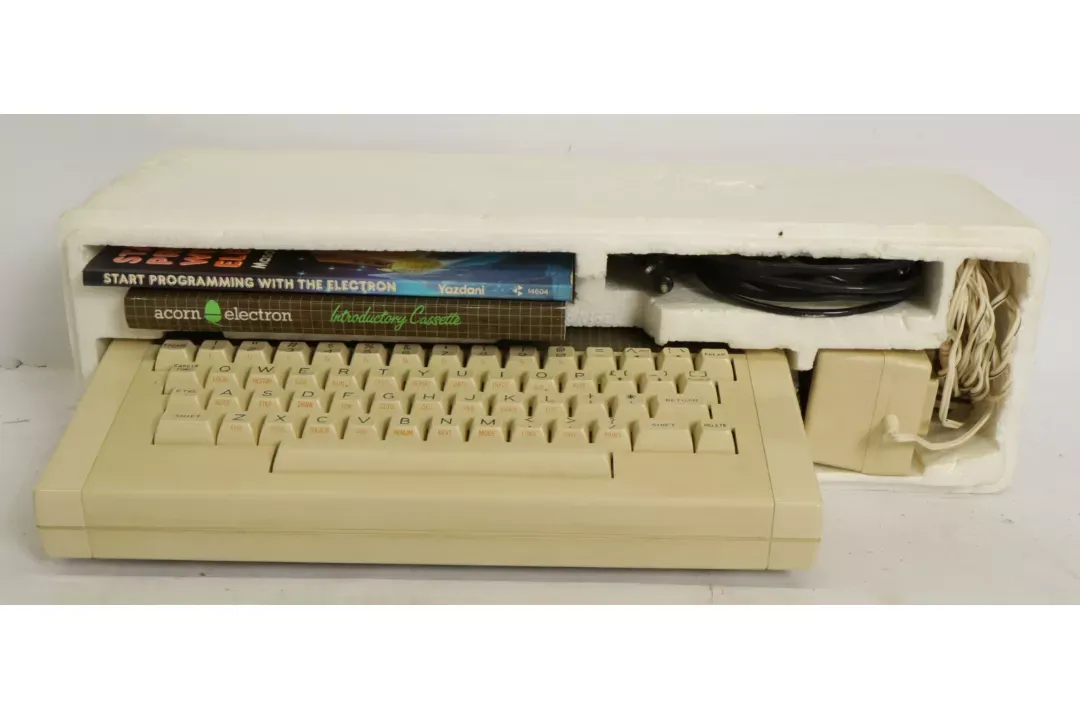
A new machine has joined the collection: an Acorn Electron, still in its original polystyrene packaging. It comes with the power supply, the leads, the Introductory Cassette and the Start Programming with the Electron book by Masoud Yazdani.
// HISTORY
Acorn launched the Electron in 1983 at £199 as a cheaper home version of the BBC Micro. To cut costs, it replaced most of the BBC's chips with a single custom ULA. It kept BBC BASIC and most of the BBC's screen modes, so much of the BBC's software could be adapted for it.
Problems making the ULA meant Acorn could only supply a fraction of the machines ordered for Christmas 1983. By the time production caught up in 1984, demand had moved on to the Spectrum and Commodore 64, and Acorn was left with large unsold stocks. Those financial troubles led to Olivetti taking control of Acorn in 1985.
// SPECS
CPU ........ 6502A @ 2 MHz (slower when the screen is accessing RAM)
RAM ........ 32K
ROM ........ 32K, BBC BASIC and the Acorn MOS
VIDEO ...... ULA, modes 0-6, up to 640x256, 8 colours (no teletext mode 7)
SOUND ...... 1 channel
STORAGE .... cassette
I/O ........ expansion edge connector (for Plus 1, Plus 3 and others)
// HOW IT WAS USED
The Electron was a home computer for families who wanted something BBC-compatible at a lower price. Children could run the same kind of BASIC programs at home that they used at school. Its keyboard allowed BASIC keywords to be typed with a single shortcut. It had a strong games library too, including Elite, Repton, Citadel and Exile, and budget labels such as Superior Software kept releasing games for it until the end of the 1980s.
// WHAT'S NEXT
Here's the plan before it gets switched on:
[ ] unbox and inspect the machine
[ ] check the power supply output
[ ] power up and check the video output
[ ] load the Introductory Cassette
Progress updates will be posted here. For more vintage machines, see the hardware section.